How many steps do you actually need?
Short answer: probably fewer than you think, and the exact number depends on your age. The benefit curve rises fast at the start and then flattens.
If you have ever wondered whether 7,000 steps is “enough”, you are asking a better question than the one most apps answer. Here is what the research actually found.
The curve bends early
Two studies get cited more than any others on this.
In 2019, researchers at Harvard followed about 16,700 older women, average age 72, and tracked their step counts against how long they lived. Compared with women averaging 2,700 steps a day, those at 4,400 steps had significantly lower mortality. The benefit kept improving as steps rose, then levelled off around 7,500. Walking faster made no extra difference once total steps were accounted for.
In 2022, a bigger analysis pooled 15 studies covering roughly 47,000 adults across four continents. It found the same shape, with the plateau depending on age:
- Adults 60 and over: benefits flatten around 6,000 to 8,000 steps a day
- Adults under 60: benefits flatten around 8,000 to 10,000 steps a day
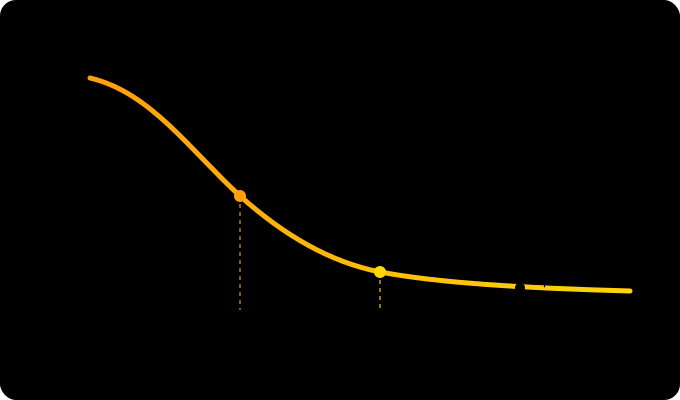
Look at where the line is steepest. It is not between 9,000 and 10,000. It is down at the bottom, between roughly 2,000 and 6,000.
That is the actual headline: the person who gains most from walking more is the person who currently walks least. Going from 3,000 to 6,000 is a bigger deal than going from 9,000 to 12,000.
What this means if you are already active
If you comfortably hit 12,000 a day, none of this says stop. More steps kept showing small additional benefits in these studies, and they were not harmful. It just means the returns get smaller, and you are allowed to stop treating a 9,400 day as a failure.
What this means if you are starting from very little
It means the gap between where you are and where it is worth being is smaller than the internet implies.
If you are at 2,500 steps a day, you do not need to find 7,500 more. Getting to 4,500 is a meaningful move on its own, and it is a realistic one. That is roughly a fifteen minute walk.
A caveat worth stating plainly. These are observational studies. They show that people who walk more tend to live longer, not that walking alone caused it. Healthier people walk more to begin with. Researchers adjust for what they can, but the effect size is probably somewhat overstated. The direction is well supported; the precision is not. And none of this is medical advice.
So what should your goal be?
Forget the population averages for a second. The number that works is the one you will actually hit, most days, for months.
Here is the approach I would use:
- Walk normally for a week and look at your average. Do not try. Just measure.
- Set your goal about 10 to 20 percent above that. If you average 5,200, set 6,000. It should feel like a stretch on a lazy day, not a fantasy.
- Hold it until it feels routine. Usually a few weeks.
- Raise it, and repeat.
This is unglamorous and it works, because it never puts you in the position of missing your goal every single day. A goal you miss constantly stops being a goal and becomes background noise.
The sources
If you want to read the originals rather than take my word for it:
- Lee I-M and colleagues, Association of Step Volume and Intensity With All-Cause Mortality in Older Women, JAMA Internal Medicine, 2019
- Paluch AE and colleagues, Daily steps and all-cause mortality: a meta-analysis of 15 international cohorts, The Lancet Public Health, 2022
Find your number, then beat it
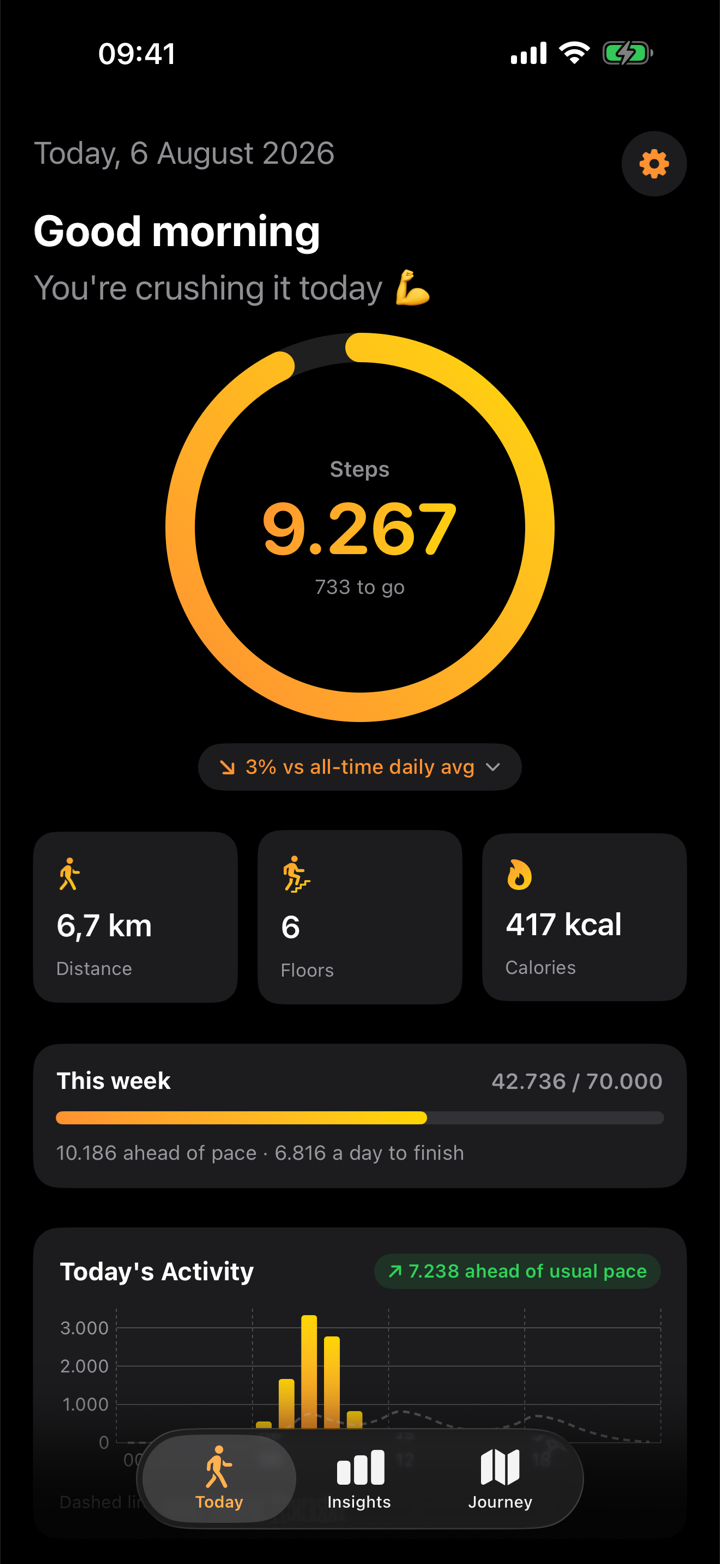
YourMoves shows your real daily average, lets you set any goal you like, and tells you when your average has outgrown it. No 10,000 step default you cannot change.
See what it looks like